
I’m sure it won’t surprise you that I have worked with and loved many horses throughout my life. Some were with me for a long time, while others simply passed through, but one thing that I can say for certain is that each and every one has taught me something. The interesting thing about lessons, I find, is that we rarely notice them in the moment. But further down the line, sometimes even years later, we will have a “lightbulb” moment and see it clearly! While writing my newsletter last month, I started to share some of the lessons that I have learned from horses and once I started writing so many more came to light, far more than I could fit in the newsletter. So, I thought I would share some more here.
The horse that taught me how our early experiences of loss can show up years later
As a small child I had three ponies, including a grey pony called Dainty. At the time I was too young to be able to understand the concept of “relationship”, but what I do remember is the feeling of pure love I had for Dainty and the three other ponies in my life at that time. They were my best friends! However, the lesson from Dainty only came to me many years later when I found myself grieving for him as an adult. This came about when I was in Arizona at the very start of my EFL journey, and during my stay there one of the horses at the training facility died unexpectedly. This resulted in a week of grieving for the loss of a beloved horse’s life and those of us on the course were encouraged to share in that as well. During one of the sessions, I suddenly had an overwhelming sense of grief for Dainty, the pony of my childhood, and after many years I was able to honour the little girl who lost her friend. Children aren’t always able to process loss, but Dainty taught me that a deep sense of loss can show up many years after it happened, and grief can show up long after we thought we had forgotten it. Most importantly, it’s never too late to acknowledge a loss and grieve it.
Horses are masters at bringing our own feelings to the surface
I started competing at a young age with a 13.2 pony called Maverick. We tried a bit of everything, and our lovely relationship resulted in a fair amount of success in various competitions. But it was a beautifully mannered pony called Mannie who helped me realise something about own desires, or lack of in this case. You see, Mannie would only jump to about 2’6 and no higher. Looking back now I feel that this was probably my first connection with a horse showing me that I had a cut-off point when it came to jumping, which could have been caused by the height of the jump, the situation, the relationship with the horse or the lack of belief in myself. I’ve also come to believe that it was my first experience of the horse letting me know of their own limitations! In this case I believe that Mannie had his own cut-off point for jumping and that this mirrored to me my own discomfort of jumping. Since then I have experienced many situations where a horse has refused to do something that the rider later confesses to not wanting to do themselves.
My pattern of throwing myself in the deep end
Although Mannie had been mirroring an anxiety regarding jumping when Dusky Princess arrived in all her 14.2 glory, because of her confidence I found myself pushing myself to jump hedges bigger than I was comfortable to jump, even though I was terrified. Looking back now this kind of behaviour was very much a pattern for me, so much so that Dusky Princess arrived on the Wednesday and by the Saturday we were already competing together, even though we’d hardly had any time to get to know one another. Not only that, we also went straight in at the Junior Open level of jumping 4’1 fences. I remember having the option to start our competitive journey together in a novice class where the jumps would have been much smaller and the competition would have been much more relaxed. If I had chosen this route, it would have been an opportunity to get some practise with my new horse and, in hindsight, I think this is probably what I wanted to do. But I had a feeling of shame around not pushing myself to be competitive. I can’t really recall how well we did in competition together and this is probably because my core memory of this time was the big competition that used to be held at Ashton Court in Bristol. I made it as far as the third or fourth fence when Dusky Princess refused and ran into the next one. We were eliminated and my riding instructor at the time heard the moment over the tannoy – “ROSEMARY APPLEYARD ELIMINATED”. I remember so clearly the sense of humiliation I felt when Dusky Princess started to show signs of refusing and then ultimately stopped. Looking back now I believe this perfectly capable horse lost confidence because I wasn’t confident and was forcing myself to compete in a way that I wasn’t ready for. Over the years I have seen this kind of thing happen so many times with riders and their own horses that I have worked with.
A really positive thing that came from my relationship with Dusky Princess was how wonderful she was at cross country events and how much I enjoyed these. To this day what I love about cross country compared to show jumping is how it feels less like a performance. Unlike show jumping, cross country allows you to just be with your horse without all the eyes watching you around the whole course. Dusky Princess showed me that show jumping wasn’t for me.
The lesson of ‘throwing myself in the deep end’ didn’t hit me until years later when I was in Arizona and we did an exercise where we had to lead a horse that we didn’t know away from the yard. We were asked to check in with our body and the horse as we walked away to feel how far we felt comfortable going together, and then, make a mental note of the point where we felt like we wanted to turn and come back to the starting point. The exercise was about comfort zones and helping us to recognise our own feelings of vulnerability and allowing ourselves to acknowledge and act on that feeling, at the same time to stay aware of the horse and their body movements and behaviour. I was given a very relaxed grey pony and I can’t remember any feelings of vulnerability while we were walking together so we ended up walking quite far away from the yard, much further than everyone else had gone. Suddenly I had a sense of “I’ve gone too far” and so I turned round and hurried to get back, feeling very agitated and perhaps a little self-conscious. The lovely little pony had a bit of arthritis and as we were rushing to get back he stumbled and grazed his knee. In this mortifying moment I was able to recognise the pattern that Dusky Princess was showing me all those years ago, that rather than check in with how I am feeling, I am prone to jumping in at the deep end. By going to such extremes in the first instance I created situations where I felt uncomfortable, and this would often result in mistakes and little accidents rather than allowing myself to enjoy the shallow end and build up to things gradually.
Valuing relationships over performance and competition
During my teen years, while I was doing my exams, Dusky Princess was put in foal and I had a couple of years off from horses and competition. I soon found myself missing horses so much that I set out to surround myself with them again and acquired a number of wonderful, kind horses who I got to enjoy spending time with, grooming, riding and training. None of them were interested or able to compete and every time we set out to try they’d lose shoes or develop a leg injury beforehand. At the time I confess to finding this frustrating (possibly because I thought I was expected to compete with whichever horse I had at the time) but looking back now I really believe they were trying to teach me that what brought me most joy was NOT competing but simply building and enjoying the relationship.
Much later in my life, I was taught a very similar lesson by my horse Jack. He really showed me the meaning of loving and being loved and fundamentally, this sums up what is most important for me when it comes to the horses in my life. It’s not about trophies, performing or living up to the expectations of others while neglecting our own wants and needs, it’s about the relationship that can come from simply spending time with and caring for a horse. I enjoyed competing as a way of assessing and confirming the level of training we’d achieved through that relationship. Nurturing horses has always allowed me to give something back to myself.
Achieving the impossible – what you can achieve with the right relationship
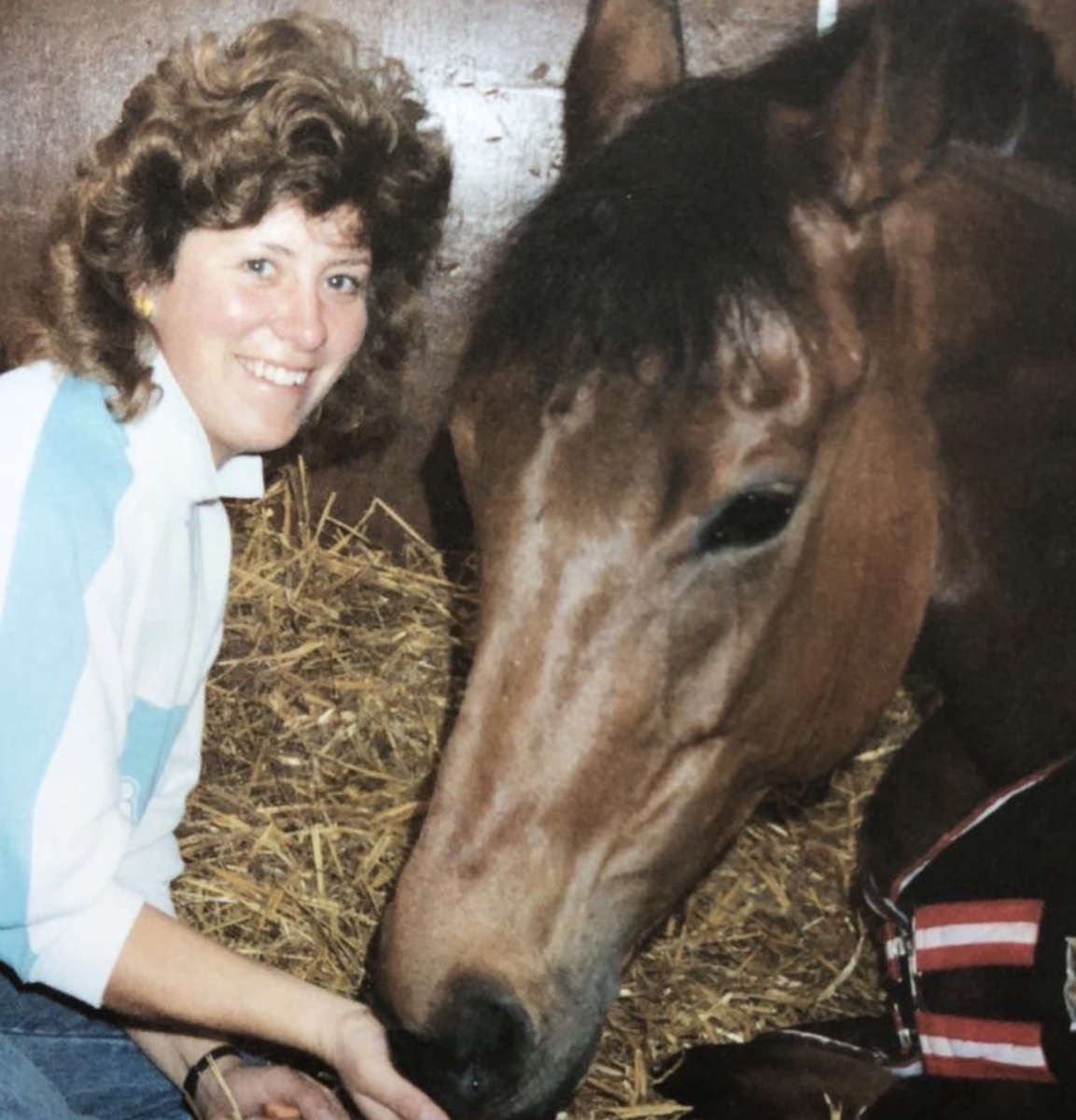
In my twenties, shortly after I started teaching, I was reacquainted with one of the progenies of Dusky Princess, a bay mare horse called Dusky’s Spirit (the horse in the image I have chosen for this blog). My Mum had reared her from a foal and sent her away for training and a local girl had started competing her. One day she told Mum that she was unable to ride ride her any longer and this presented me with a new opportunity. One of my first impressions of Dusky’s Spirit was that she could be bad tempered and a little bit of a live wire in the stable, but still I found myself agreeing to ride her at a competition. I quickly learned how sometimes the right horse comes along when we least expect it and turns into a very special relationship indeed. There was nothing we couldn’t do together because we trusted each other completely and we ended up achieving something I had always thought impossible, a point-to-point ride together. When I came to do my very first Epona session I found myself standing in front of a bay gelding who was spinning around in his stable. Suddenly the fear that must have been charging through my body at that point-to-point ride came flooding back, but with it also came the memory of how I fully believed Dusky’s Spirit and I could do it and this belief was the driving force in helping us achieve a 1st, 2nd and 3rd place in three races. When I think back to this period of my life I can see how, despite many occasions when I didn’t want to compete, when the right relationship was formed I was able to achieve something I never thought I would.
The legacy of Dusky Princess – the pony of my teenage years
I could share so many more lessons from this family of horses I loved but this blog is already long enough! Dusky Princess’s four grandchildren all led me to complementary therapy, including the Tellington Touch. Because of their own health problems I really came to learn that the main cause of unwanted/undesirable behaviour is often physical discomfort. How lucky I was to have lessons from three generations of the same family of horses. The first helping me to push myself beyond my limits while also teaching me to recognise when I am doing something that goes against what I really want. The second bringing me back to the importance of relationship and how that can help us achieve the most wonderful things. And the third bringing me to the start of where I am now in my life and career. This family of horses all managed to find ways to teach me something about myself.
Perfection – Trauma – Letting Go – Boundaries
Before I wrap up this blog I would like to share a few more quick lessons that I feel have been important in shaping who I am today.
Solomon was the horse who found it difficult to canter on the correct lead when he was moving on the right rein (clockwise). As I was quite sure that it was a physical issue I invited the chiropractor to come and give him a treatment. What was interesting is that after his treatment and him being ridden again I found that my clients were able to achieve canter with him on the correct lead on the right rein, but that I couldn’t! Imagine my frustration! Eventually I found a way and it’s now with hindsight that I believe that Solomon was picking up on my need for perfection instead of feeling free to simply roll into canter in a way he felt was right for him and this was blocking him from responding to me. To this day I sometimes have to remind myself that a job well done doesn’t have to be perfect and the journey is as important as a flawless result, especially when recovering from a setback such as health issues. Solomon was giving me a clear message that he knew what was right for his body and it was my expectations that needed to be adjusted not his delivery!
A coloured horse called Legs taught me that sometimes we can’t heal completely from trauma and it’s ok to make adjustments to accommodate it rather than force ourselves to face it. Many years before Legs came along I had been working with a horse who, while cantering on a left circle started to bronc. I was terrified and couldn’t bring myself to ride him again. One day I was riding Legs around the village when a motorbike came around the corner towards us, panicked when he saw us and tried to brake hard causing him to skid on his side. He ended up on the ground across the other side of the road in front of us and Legs was terrified. I couldn’t let go of him to see if the bike rider was ok so I had to stop a car driver to ask them to attend to the potentially injured man while I got myself and Legs home and away from the situation (thankfully I later heard that the bike rider was fine). Legs never really recovered from that experience whilst he was with me and whenever he heard a motorbike or similar noise he was petrified despite how much I tried to help him through it. Of course, my own emotional arousal was also heightened by the sound of a motorbike when riding Legs and that would not have helped him to overcome the issue either. When I decided to sell him he went back to the people he’d come from who lived on the Quantock Hills – and where he didn’t have to ride on any roads! We may not always be able to get over traumas but if we understand and accept it we can find ways to adjust our lives to accommodate it.
Chippy was one of my ponies at the riding school and he loved to teach. Until one day I sensed that he didn’t. The realisation that Chippy was no longer enjoying the life he had previously loved coincided with my own decision to sell my riding school business for my own pastures new. Sometimes we need to recognise when things aren’t bringing us joy anymore and let them go so we can invite new opportunities in.
I’ve already touched a bit on Jack and how he taught me how to love and be loved. Jack also taught me how to let myself be assertive in setting my boundaries, something I had always struggled with. You can read more about the many lessons Jack taught me here.
Finally, I can’t talk about horse lessons without mentioning my beloved Bramble. Bramble didn’t always want to be touched or interacted with physically and she was very clear about this, which sometimes seemed to disappoint my clients who were drawn to her. So, she also taught me the importance in being clear about my own boundaries. Another lesson Bramble taught me is that sometimes the best relationships are the ones where you can be together while doing separate things and there’s a quiet joy in being so comfortable with someone that you don’t need to be really close to them all the time.
As I write this I am once again reminded, as I am so often, how blessed I am to have grown up with horses as constant friends, confidantes and teachers. I don’t take a single one of them for granted and, as you can probably tell, I remember all the horses that are no longer with me fondly, even the ones who presented me with the hardest challenges. Thank you for joining me on this journey down memory lane.
If you enjoyed this blog you might like my story about a horse called Amber who I nicknamed the boomerang!! You can read that here.
